
Defibrilators are interesting. Electrical devices to shock people. Like a taser with medical credentials.
I'm told that you should not use a defibrilator by a swimming pool - and throwing the thing into the swimming pool is a bad idea. Yes: I asked. Had to. The answer was quite emphatic. (And dismissive. But I ignored that part).
So: Like a taser, a defibrilator can probably be dangerous in the wrong hands. Defibrilators tend to be somewhat bulky, which at least explains nobody has been mugged by being threatened with a pair of defibrilator pads.
And then my mind wandered.
Electric current through your body can be dangerous as your body is (partly) an electrical system. Nerves are driven by electrical signals, muscles are driven by calcium ions being moved around.
But what if you used electricity on something which was already dead? Yes: I know the story about Frankenstein and his "monster" (Adam), but that's not where I'm going.
Rather: Putting eletricity through things tend to heat those things up. So.. Can you use it for cooking? Can you actually cook a chicken with a defibrilator?
It seemed like a fun thought.
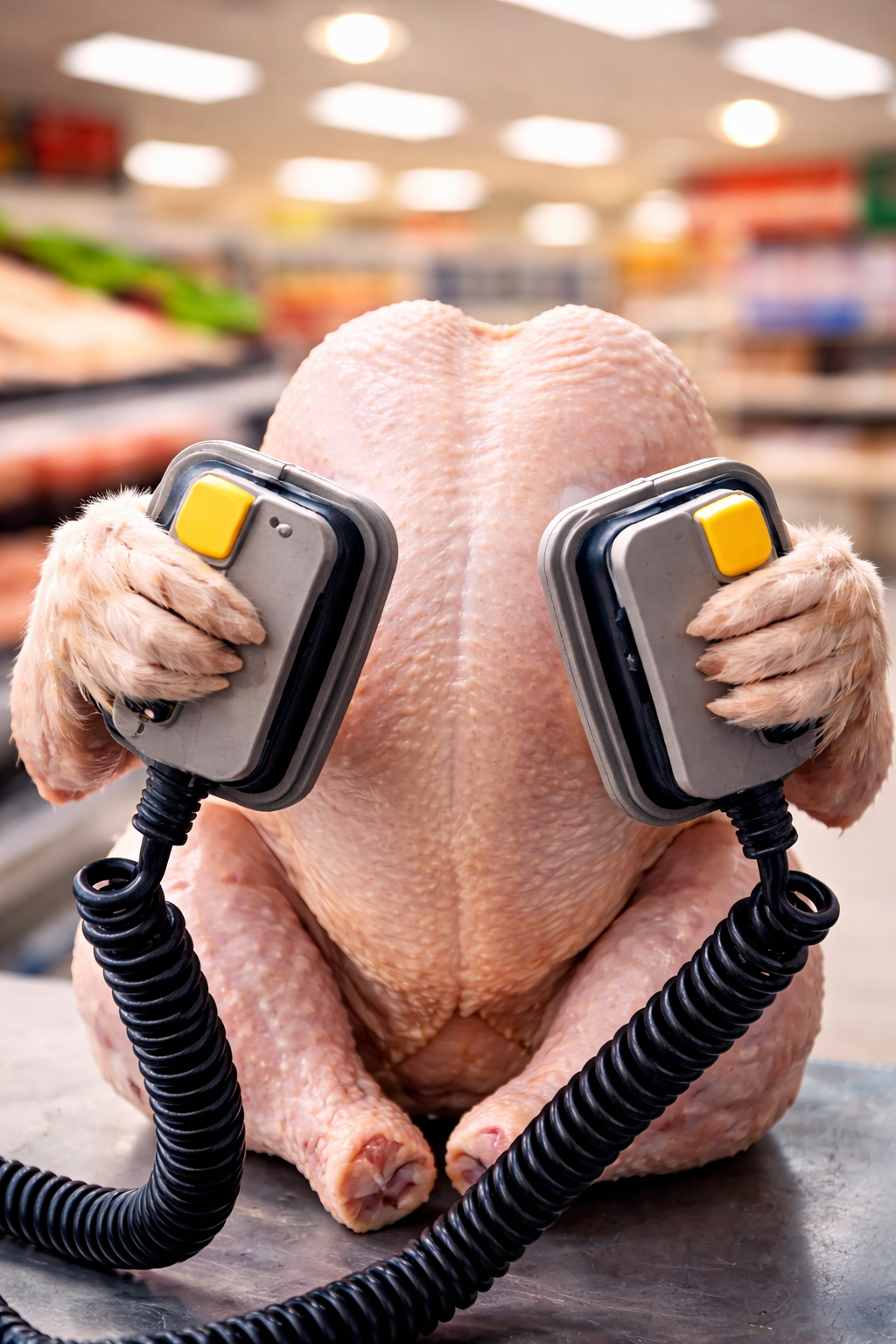
But... Why leave it as a thought !?
Is there enough energy in a typical defibrilator battery to cook a chicken? That is a question which seems answerable with pretty simple physics and maths.
-
Assume a small whole chicken - about 1.2 Kg, like this one from Waitrose. It is a "slower" chicken, which (in my mind) should make it react well to a jolt of electricity.
-
According to cookingtimeforchicken.com (which surely must be authorative - just look at the domain name!) we need to bring the chicken to 75° C for 1 hour and 20 minutes. Some adjustments are needed depending on the altitude (because that affects the boiling temperature of the water contents of the chicken), but we will just assume sea level here.
-
Let us assume a perfectly insulated oven - no heat loss. We're being efficient here, and heat loss probably complicates the calculations... Besides: I'm planning to electrocute the thing, so it will be heating from the inside, which helps combat the heat loss - although a lovely layer of insulating feathers would probably help.
-
Defibrilators and batteries vary, so I picked a random one, which displays specs of 12V, 4.2Ah & 43Wh. I had expected more. But it shows how little electricity is needed and thus how electrically-efficient our bodies must be.
-
We take the chicken out of the fridge and let it come to room temperature first. Let us assume a lovely toasty room temperature of of 18°. At least that's what moneyexpert.com says.
-
The specific heat of chicken is 4.34 kJ/kg = 4.34 J/g. Yes: there are people out there who study the thermal properties of foods!!! (Nerds: I salute you - this is definitely an under-appreciated science)
So we need to raise the temperature of the chicken 75° - 18° = 57°, which takes an energy of 57° × 4.34 J/g/° = 247.38 J/g, which makes for 1200g × 247.38J/g = 296,856 J in total.
With 1J = 1 WattSecond, we need 296,856 Watt Seconds.
Our battery had a capacity of 43Wh (Watt Hours), which makes for 154,800 Watt Seconds = 154,800 J
So we cannot cook that chicken - we have insufficient energy available. Our battery is too small.
Another way to look at is: Our chicken is too big.
So what can we cook? Starting with the battery capacity, we can then work out the max size of the chicken:
154,800J / 54° / 4.34 J/g/° ~= 660.5 g
Unfortunately, this makes for a rather small chicken, but not too bad! It seems achieveable! But we have not yet cooked any potatoes, vegetables or or made gravy. And the after-dinner coffee remains a dream.
We need bigger batteries.
And some way to explain to bystanders why the defibrilator no longer works.